Why A Business AI Voice Agent Isn’t “Set And Forget”
AI voice agents are becoming the norm now in many small businesses, from restaurant bookings, to organising a dental appointment, voice agents are able to handle a huge range of business workflows and use cases. In fact, you’ve probably already spoken to an AI voice agent over the phone.
Throughout 2025 we’ve spoken to a huge range of businesses across the UK, and it’s not just
For most UK businesses, the objective of an AI voice agent is simple – fewer missed calls, fewer interruptions, less time wastage and more qualified outcomes.
The reality that most businesses will face within a few weeks of launch:
- The agent starts getting tripped up by real callers
- Edge case calls multiply
- Scripts and tools that looked neat in a Google Doc feel clunky on a live call
- Latency between responses can vary wildly
- Contact details often recorded wrong
- You start seeing “I didn’t catch that..” more than you’d like in transcripts
The problem usually isn’t in the tech, but the assumption that an AI voice agent is a one-off “set and forget” project instead of a living system that needs continuous optimisation from real-world calls – something that you’ll often not find from an off-the-shelf voice solution company.
Choosing the right AI voice solutions partner to build, and more importantly maintain your AI voice agent system is critical for longevity and a successful system.
This guide walks you through what that voice agent optimisation actually looks like in practice, and how to get the best out of your voice solution.
If you want your voice agents to keep on improving rather than quietly deteriorating then our guide is for you.
The big mistake: treating your AI voice agent like a finished product
Most AI voice implementations follow a similar pattern: Someone will write a detailed system prompt, you then plug that into an AI voice platform such as Elevenlabs, VAPI, or Retell etc., then a few internal test calls and finally you go live.
For a short while it works, and everything looks fine.
Then real callers start arriving with real accents, background noise, poor signal, half-formed questions and urgent questions.
They:
- Talk over the agent
- Answer yes/no questions with long stories
- Ask for a “wee bit more information” than you had prompted for
- Mention products, brands or agencies the agent has never heard of
- Recognise they are speaking to an AI and try to break it
Suddenly:
- Calls loop, questions are re-asked
- People hang up halfway through qualification
- Potential customers get frustrated with a negative first impression
- Your team gets patchy, unhelpful handover notes
Nothing is “broke”, that’s the way the system was developed. You just hit a point where the real world diverged from the neat logical flows you started with.
As with most development or systems – even the most planned out flows need adjusting and improved when out in the real world.
This is exactly where continuous optimisation should kick in.
What “continuous optimisation” actually looks like
Continuous optimisation is not “tweaking the prompt now and then” or “sending an email with call numbers“. It’s not even just “giving you access to the voice platform“.
It is a structured process of:
- Listening to real calls and analysing transcripts
- Spotting where customers get confused, frustrated or lost
- Updating prompts, flows and integrations so those issues disappear
- Measuring what changed – and doing it again
Think of it like ongoing training and coaching for a top-performing call handler. Except in this case, the “handler” is an AI system made up of:
- System prompts and instructions
- Conversation flows and state logic
- Guardrails and compliance rules to follow
- Integrations into your CRM, booking tools and job management systems
Each of those pieces can be tuned on what your callers actually do and say on real calls.
Using call analysis to drive real improvements
The most powerful optimisation tool you have is simple: it’s the call logs.
Many agencies and AI voice freelancers will rely purely on the voice platforms (Elevenlabs, Retell, VAPI etc.) to provide them with call logging and data. This might get you half-way, but to build a powerful optimisation system – you must have observability.
We build our voice systems with full end-to-end observability:
What made a user drop a call?
Did the agent repeat itself?
How many times was a tool called?
How many tokens did a call use?
These are all aspects to an AI voice agent ecosystem that you need to understand to optimise for performance.
The best AI voice agent agencies will spend a lot of time inside:
- Call recordings (where compliant)
- Transcripts
- Call outcome reports
We’re asking specific questions with this data such as:
- Where do callers most often hang up?
- Which questions are commonly misunderstood?
- At what point does the agent start sounding repetitive or robotic?
- What edge case conversations are causing inconsistent results?
- Are we gathering the right data? in the right order?
- Do handovers to humans leave them with the right information they need, or are they re-asking the same questions?
- Are we capturing contact details correctly? e.g. are emails valid?
- What is frustrating users the most
From there, we turn observations into actual optimisation improvements.
At flowio – we build supporting tools around our agent ecosystems that enable deep observability and live analysis of transcripts that creates consistent improvement frameworks.
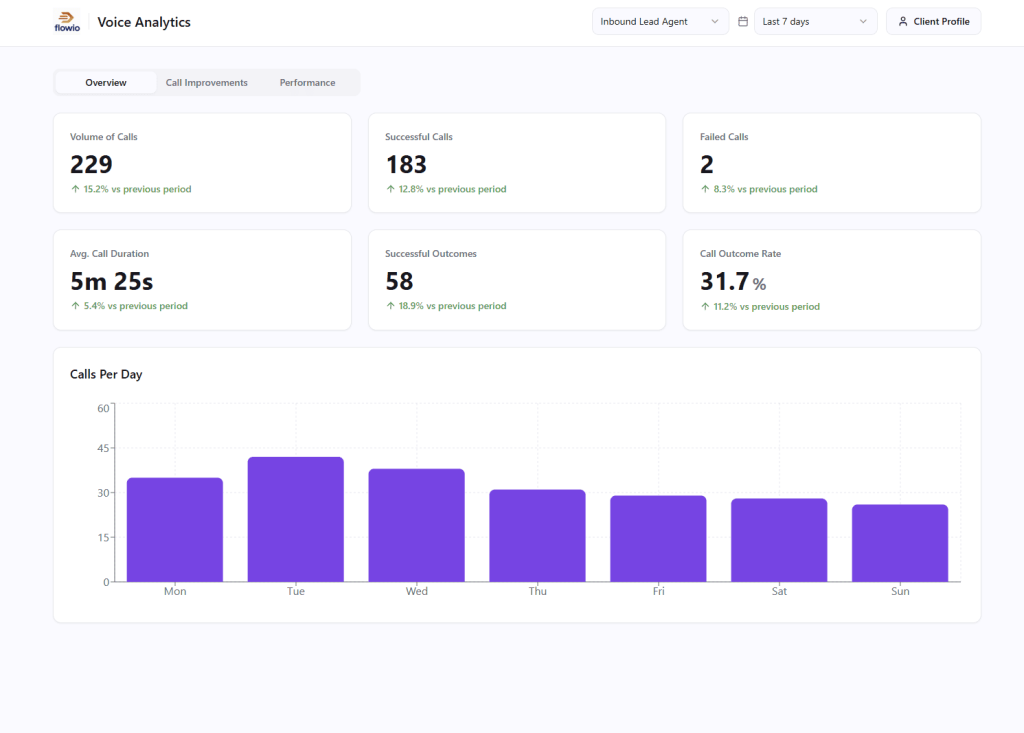
All of which is available in our client reporting dashboards – the following is just a few examples of what comes through from transcript analysis that lets us improve conversations:
| ✨ Reduce generic filler when user is already informed – The agent replied “If you have any questions…” in 3 calls right after they had answered or when a user had confirmed understanding already. – Add brevity guidance for the agent: once the user has acknowledged, don’t restate instructions unless something new is added. |
| 😊 Sentiment-aware empathy tweaks – Where users mention an immediate need, the replies are polite but could acknowledge the situation slightly more directly (without adding length). – Add one line in the style guide suggesting a brief empathy phrase before giving the standard next-step message. |
| 📅 Improve date wording and handling – One call proposed Friday the 28th, but for alternative options chose to say Monday 1st December. – Add a block telling the agent to always be consistent with date formats to avoid any ambiguity. |
Good AI voice agencies will provide you with the tools, and visibility to manage improvements – and the best voice agencies will provide a proactive improvement approach, so you are able to be hands-off knowing your system is delivering, not taking away business.
At flowio – we provide a real-time customer AI agent dashboard. Showing all of your agent performance across clear KPI metrics. Including sections to view transcripts, analysis and apply suggestions back into your voice agents.
Prompt engineering as a living document
Behind every good voice agent there’s usually not just one prompt, but a whole library of version-controlled prompts and instructions that evolve over time.
One critical component of building a good voice system is maintaining the system prompt; version control, controlled testing, modular design and real-time feedback.
They’ll maintain things like:
- A core global system prompt that sets tone, boundaries and behaviours
- Separate prompt blocks for
- Opening and closing scripts
- Qualification flows
- Compliance statements and disclaimers
- Escalation and handover rules
- Tool and webhook/API usage
- Handling abuse, emergencies or sensitive topics
Prompting is what makes the difference between an average system to an impactful voice system that actually hits your objective outcomes.
While there is much more to a voice agent than its prompt – prompt engineering is a significant part of what makes a good system great, and the best AI voice agencies will understand how to craft, version and test prompts alongside staying compliant within your business use cases.
Example: Staying helpful without giving advice
Take a debt management or financial services agent.
You may need it to:
- Ask about income, debt amounts and current lenders
- Determine whether the caller fits your criteria
- Be absolutely clear that it cannot provide advice or recommended products
- Offer signposting (e.g. Citizen’s Advice) when someone doesn’t qualify
This means carefully structured instructions and guardrails along the lines of:
- “Never offer financial advice or a solution to financial challenges”
- “Make it clear that only a human advisor can give regulated advice”
- “If a caller asks for advice, say you can connect them to a specialist”
Once an agent like this is live, you’ll quickly encounter real questions that weren’t in the original brief:
- “My partner’s debt is separate, does that count?”
- “I’ve already spoken to another firm, can you match their advice?”
- “I’m not sure exactly how much I owe, what can I do?”
Being able to catch these issues they happen and have prompt updates to deal with any new conversation cases, or additional guardrails to prevent the scenario from happening next time is key.
A common misconception is that an AI voice agent will be perfect from the outset – that it will be able to handle any off-topic, or random conversation. Building and optimising voice agents is an iterative approach that requires constant attention.
Test, test, test
Before deploying a live voice agent – a rigorous testing phase is crucial.
We can be brutally honest here as we build many real-world AI voice agent systems. Testing is the most time-consuming and tedious part to building a great AI voice agent.
Live call after call needs to take place to test, refine and optimise a voice system to get it production ready.
Most AI voice builders will set up an agent, test it a few times with their mobile and push it to production. That’s where issues arise, in the real-world conversations do not happen as we think they will during development. From listening to call recordings and analysing call transcripts – you’ll immediately start to see that human conversations do not follow a logical flow that AI agents need to follow.
A key component of a robust test programme will include:
- Structured test patterns for common and edge occurences
- Trying to break the agent with unexpected conversation
- Testing the guardrails to make sure the agent behaves the way it should
- Testing tool call latency
- Testing full flows in multiple ways (different accents, responses, background noise etc.)
- Perform Evals on the AI responses
- Provide structured documentation on testing performed
A structured AI voice agent testing programme can make the difference between an agent that that “just about gets it right” to one that seamlessly operates efficiently within your business.
The difference between a voice agent that is set live and left to its own devices versus a voice agent system that has a structured maintenance and testing plan behind it is the key to whether your system scales with you, or becomes an obsolete technology (and often a waste of money).
The outcome: robust voice systems that have already been thoroughly put through their pace before going live.
Guardrails, safety and brand tone
As your voice agent handles more calls, two other topics start to become crucial: guardrails and tone.
Guardrails: what the agent must never do
Without clear guardrails, an AI system can:
- Drift off-topic
- Guess when it shouldn’t
- Accidentally give advice or information it isn’t qualified to give
Continuous optimisation includes:
- Explicit “do not answer” zones – questions that must be escalated
- Rules for abusive or vulnerable callers (e.g. how to respond, when to disconnect or escalate to a human)
- Guardrails for sensitive topic like health, finance, legal or safety issues
- Business specific guardrails
- Fallback behaviours if the underlying AI model fails or responds unpredictably
These are never set just once – they evolve and iterate over time each time you see a new edge case on real calls.
Tone: sounding like your business, not a generic bot
Even a technically solid agent can damage your brand if it sounds:
- Too robotic
- Too informal for your audience
- Completely different in tone from your website and human team
A good voice platform will offer ways of customising voice accents, tone, patterns and inflection points. An experienced AI voice agent agency will be familiar on how to control tone, pitch and voice patterns to match your business. Prompt updates often focus on subtle tone shifts:
- Shortening overly formal phrases
- Making empathy sound natural, not forced
- Matching regional language or phrases your customers naturally use (we tend to do this a lot for our customers in Scotland and the North East of England!)
- Adjusting the balance between “chatty” and “to the point”
Expert voice agencies that understands your brand voice and your sector will keep these prompts aligned as you scale the system to more numbers, campaigns and use-cases.
Operations, integrations and “under the bonnet” optimisations
A great call experience is only half the job of an AI voice agent. Whether you have a voice agent amending appointments for your dental clinic, or following up leads automatically for your solar installation company, there is usually much more that goes on behind the scenes.
The other half of the job is everything that happens behind the scenes:
- Where call data is stored
- How sessions are tracked
- How notes and outcomes are written back to your CRM or job management system
- How bookings are created, moved or cancelled
- How out-of-ours or overflow routing is handled
Over time, your workflows may need changed. You might:
- Switch CRM or job management tools
- Add a new sales pipeline or calendar
- Introduce new service lines or eligibility rules
- Turn on SMS follow-ups or WhatsApp flows alongside the voice agent
Without someone experienced actively maintaining the plumbing, you end up with:
- Fragile flows that break easily
- Duplicated records and messy data
- Agents that say one thing while your system shows another
An AI voice agent company that lives in these systems and integrations day to day will:
- Design robust session and state handling – so the agent always knows where it is in the conversation, and provides memory from previous interactions
- Keep payloads and handovers structured and consistent
- Refactor flows as campaigns and voice systems evolve
- Optimise rigorously for latency reduction so calls don’t feel sluggish even when there are multiple APIs or tool calls involved
It’s the stuff that clients rarely see and callers never see – but definitely feel when it goes wrong.
We get approached by businesses that already have voice agent systems built from other suppliers. All of which usually have similar issues – high latency, poor contact capture, errors, hallucinations and even serious issues such as advising callers on their entire system prompt. These are all easily solvable issues – and its worth partnering with an experienced AI voice agent agency that understands how to build a quality voice agent system.
Why an agency (not just a freelancer, or someone internal that likes AI)?
Could you build and optimise a voice agent from someone on UpWork, or even in-house? Yes, in theory.
The challenge is that doing it well requires multiple skillsets that rarely site with one person – whether that’s a sole trader you found on TikTok selling voice agents, or the employee that wants to own AI in-house:
- Conversation design and copywriting
- Engineering prompts, knowledge base data, trigger responses and edge cases that feel natural and are easy for an AI to interpret.
- Technical architecture and integration
- Understanding APIs, webhooks, CRMs, booking systems, data privacy, compliance, cloud architecture, error handling and observability.
- Analytics and optimisation discipline
- Consistently digging into call data, spotting patterns, and turning them into structured improvements.
On top of that, most in-house teams already have full-time jobs which is why they are looking for time-saving and efficiency improvements in the first place.
A specialist AI voice agency partner brings:
- Tested flows and patterns from multiple clients and industries
- A library bank of prompts and guardrails from real-world voice agents
- A technical ability to build custom tools for your requirements and existing systems
- The ability to spot, and prevent issues early because they’ve seen similar behaviours elsewhere
- The time and focus to actually sit with your system and optimise week after week
With a specialist AI voice agency such as flowio – you’re gaining a long-term partner committed to the success of your voice system, and with the expertise to scale beyond just voice as your business grows.
A full voice agent optimisation programme is included within our monthly service fees for AI voice agents to give you peace of mind that your system is flawlessly taking calls and not breaking. Consider the cost differences between hiring a one-off freelancer to build your agent – how many times will you need to go back to them to fix issues or upgrade your system?
What a healthy optimisation programme looks like
If you’re working with an experienced AI voice agency, a typical optimisation cadence might look something like the following:
- 1. Launch Phase
- Deep dive into your business, call types, typical scripts, eligibility criteria and compliance needs
- Design of conversation flows, prompt, guardrails and handover logic
- Integration into your existing telephony systems, CRM and job platforms
- Overarching strategy and roadmap defined
- 2. First 4-6 weeks live
- Regular daily or weekly reviews of call transcripts and recordings
- Fast iteration on confusing questions, edge cases and drop-off points
- Tuning of model parameters, timing, and escalation rules
- Quick wins prioritised: fewer loops, clean handovers, better qualification criteria
- 3. Ongoing monthly optimisation
- Monthly check-in to review performance metric and real call examples
- Refinement of prompts and flows based on new scenarios
- Updates as your offers, processes, opening hours or routing rules changes
- Light experimentation (e.g. different opening lines or qualification orders) to improve performance
- 4. Quarterly strategy reviews
- Identifying new use cases for voice agents (outbound follow ups, renewals, cross-sell, support triage etc.)
- Reviewing compliance guidelines, and risk as regulations and policies evolve
- Deciding where to scale: more numbers, new brands, new regions, new languages
The goal isn’t perfection on day one. It’s an iterative cycle where the agent gets meaningfully better every single month. If you don’t have a voice agency that has a plan to support your agents like this – then you risk time and money trying to do it all in-house.
The best UK voice agent agencies such as flowio will proactively manage your optimisation, support and guide you through what requires implemented to improve your voice system.
An agency that can implement fixes quickly (we are often chatting through WhatsApp with our customers fixing things immediately!) and care about the performance of your AI agents will save you significant time and money over the long-term.
Signs your AI voice agent needs serious optimisation
If you already have an AI voice agent in place, it might be time to bring in help if you notice:
- High hang-up rates in the first 30-60 seconds of calls
- Frequent “sorry, I didn’t understand that” loops
- Agents asking the same questions more than twice
- Agents doing unpredicted things like providing web information
- Agents not adhering to any set guardrails
- Your team re-asking the same questions the agent is supposed to collect
- Complaints about the calls feeling “slow” or “like talking to a robot”
- Tool calls like booking or getting availability are failing constantly
- Handover notes that are inconsistent or missing key details
- No one in your business can clearly explain how the flow works
All of these are solvable problems – but they will rarely solve themselves.
Where an AI voice agent agency fits into your wider AI strategy
AI Voice agents never exist in isolation.
Designed properly, a voice agent will sit alongside other automations and AI agents within your business:
- SMS agent booking systems or follow up reminders
- WhatsApp chatbots and email automations
- CRM and deal pipelines
- Job management or booking systems
- Analytics dashboards and reporting
An agency that understands voice, messaging and automation together can:
- Make sure your voice agent isn’t just answering calls – it’s feeding clean data into your wider systems
- Reuse successful prompt patterns across channels (voice, chat, WhatsApp)
- Help you decide which parts of your customer journey should be voice and which should be messaging or email
- Ensure that guardrails and tone are consistent wherever customers interact with AI in your business
- Provide transparent and real-time reporting dashboards (not simple emails or updates)
With all of the above – that’s when AI voice agents stop being a “clever add-on”, and start behaving like proper business infrastructure.
✨How we helped a real estate agent reduce call handling time by 40%
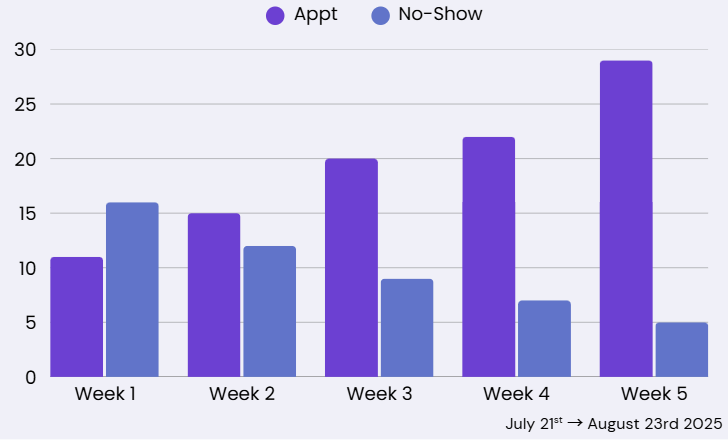
📈 3X Qualified Appointments
For a UK-based real estate lettings agent flowio deployed an AI voice agent and intelligent SMS appointment system aimed at reducing unqualified leads and missed viewings. Within 5 weeks, our AI systems had improved no-show appointments by 75% and saved their team 40+ hours in admin time dealing with calls and follow-ups.
🔎 Inbound Lead Qualification
📖 Knowledge Base Searched Properties
⌛ Intelligent Sequencing
📲 Enhanced Post-Call Information
Final thoughts: your AI voice agent is only as good as the effort put into improving it
An AI voice agent appears rather simple on the surface, some prompting, a few integrations, and then you have a new call operator live for your business. In fact, there is much, much more that goes into designing a robust, scalable voice system that will perform well for your business. Optimisation is an iterative and continuous process to keep your voice agents running smoothly, bringing in new customers and avoiding critical failures.
Choosing a voice agent agency is a crucial part of your voice system success, an experienced agency that understands how to prompt engineer, iterate, version, test and more importantly be proactive in your systems will provide you with the foundations to take AI to the next level within your business.
At flowio – we have dedicated processes, tools and systems we use to keep customer voice systems running smoothly, continuously hitting KPI performance – and iteratively improving over time. From real-time performance dashboards so you can see full call performance, to custom analysis tools that can auto-apply prompt improvements.
If you already have an AI voice agent, and would like an unbiased view on the setup, with potential improvements, book in a call with our voice agent experts.
About the author

Malcolm Gibb — Founder & CEO // flowio
Hi, I'm Malcolm — Founder of flowio. I founded flowio after 15 years of leading performance marketing agencies. flowio exists to help businesses combine AI, automation and smart development solutions to solve critical business challenges. The content you read here is written by myself and based on experiences, insights and topical content from working with our clients.
Looking to speak to an expert to help your business scale? Whether you are starting your journey into AI strategy or need a full done-for-you automation solution, book a chat with us to discover where the opportunity exists.