The AI Maturity Framework: How To Assess Your Business AI Readiness
You can’t automate chaos. You’ll only get chaos faster.
This is the reality many businesses face when implementing AI agents and automation into their business workflows. Successful workflow optimisation and AI integration requires a multiple step plan – from governance and ownership, internal change management, data pipelines, process maps to KPI benchmarking.
What do we mean by this?
Take a business who wants to automate their customer service capabilities, tasks like issuing refunds, answering customer FAQs, processing fulfilment etc. All of this might seem simple and straightforward enough to automate using AI agents, and chatbots.
However, they are using a separate CRM system, a different ERP, and half of their refund requests are stored in a Google Sheet. On top of that they changed all their product codes last year and nothing lines up in their data.
This is more common than you’d think. When you start to look under the hood of many businesses, their data pipelines are unstructured, messy, and often held together by glue.
Automating anything on top of a data structure like this would be, well chaos.
Take another example:
A business with an admin team of 10 has just built and implemented a CRM automation that assists the team replacing manual data entry when the team take calls. It should save the team around 50+ hours per week. However, no formal training has been performed with the team, and half of the team are against AI fearing it may replace them.
The project fails.
Again, this is a common scenario. For a successful automation project, it is imperative that there is a robust strategy and plan behind implementation – not only a build out.
This is why we developed the AI Maturity Framework, a simple scorecard system that dives into critical pillars to assess how ready a business is to implement AI and automation.
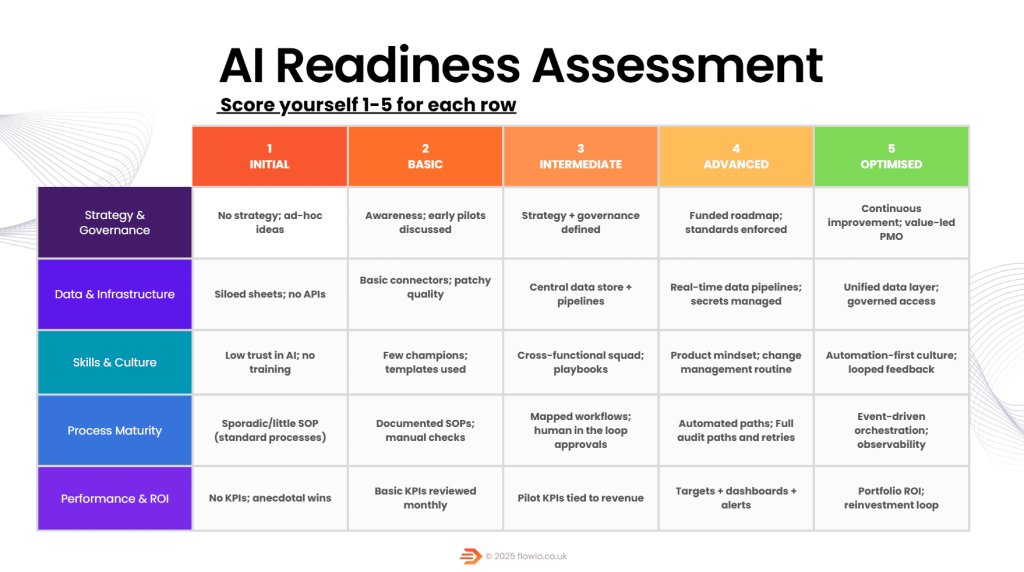
The concept is simple – score yourself 1 to 5 within each box. Pillars run vertically and a maturity status runs horizontally. Total scores produce an AI readiness assessment score ranging from 5 (min) to 25 (max) – this provides a metric benchmark for clients to understand where they are in the maturity scale and where we aim to get them to.
We segment each maturity stage from Initial (Beginner) to Optimised (AI Embedded).
This serves as our core audit methodology for each new prospect we work with. It provides a grounding to plan key automation starting points, any fundamental issues that need to be fixed before building, and a view on the best way to implement systems into their business effectively. It also provides a thorough basis on how to measure automation success within the business environment.
Let’s run through how we assess the AI Maturity Framework through each pillar:
Pillar 1: Strategy and Governance
AI agents and automation needs ownership within a business. It needs a strategy, and an idea of what could be implemented. Without this, you’re starting from scratch. Although some businesses may know exactly what they want to automate – it goes without saying, if nobody internally will own and govern the process then it will likely end in failure.
To assess AI strategy and governance within an organisation we first interview key stakeholders, understand their requirements, and technology needs. Do they have existing automations? Do they have a plan of what needs automated? Who is in charge of developing the strategy.
There are 5 levels at which we assess AI strategy and governance:
| AI Maturity Level | Key Indicators | Outcome |
|---|---|---|
| 1 – Initial | No formal AI budget. Ideas are driven by individuals, not business goals. No clear ownership of AI initiatives. | Shadow AI: Uncoordinated experiments lead to wasted effort and security risks. |
| 2 – Basic | Leadership is “interested” but non-committal. A prioritised list of potential use cases exists. Basic ethical/risk concerns raised but not codified. | Exploration: The business understands why they need AI but lacks the how. |
| 3 – Intermediate | An AI policy document exists (privacy, usage limits). A steering committee meets quarterly. Success metrics defined before pilots start. | Controlled Experimentation: Pilots are safe, legal, and aligned with broader goals. |
| 4 – Advanced | Dedicated budget line item for AI innovation. Clear “build vs. buy” criteria established. Governance gates integrated into project lifecycle. | Scalable Foundation: Moving from “pilots” to production-grade solutions. |
| 5 – Optimised | AI strategy is fully integrated into corporate strategy. Governance is automated (policy-as-code). A “Center of Excellence” actively scouts new tech. | Competitive Advantage: AI is a core driver of business valuation. |
Pillar 2: Data and Infrastructure
This is undoubtedly one of the most important pillars for AI readiness. Automating business workflows requires clean, structured data to work with. You know the old saying ‘rubbish in, rubbish out’. If you start automating on a base of poor, unstructured and unclean data – you are likely to have much of the same coming out of your AI agents or automations.
Our process involve auditing a businesses data systems, CRMs, databases and any data required for input into workflows. Some businesses may have perfectly clean and well structured data to work with, others often have scattered sources, duplication, disparate systems and require fundamental work before automating.
| AI Maturity Level | Key Indicators | Outcome |
|---|---|---|
| 1 – Initial | Heavy reliance on offline Excel/Google Sheets. Manual data entry is the norm. No documentation of data sources. | Data Paralysis: AI is impossible because data is inaccessible or untrustworthy. |
| 2 – Basic | Use of tools like Zapier/Make for point-to-point links. Data quality issues frequent (duplicates, missing fields). Basic cloud storage used effectively. | Fragile Automation: Things work, but break easily if a connected app changes. |
| 3 – Intermediate | A Data Warehouse (e.g., Snowflake, BigQuery) exists. ETL/ELT processes run on a schedule. Data dictionaries available for key datasets. | Single Source of Truth: Reporting and basic ML models can be trusted. |
| 4 – Advanced | API-first architecture is the standard. Secrets/Keys are rotated and managed securely. Streaming data available for time-sensitive decisions. | Operational Agility: Systems react to real-world events as they happen. |
| 5 – Optimised | Data mesh/fabric architecture in place. Granular, Role-Based Access Control (RBAC). Synthetic data used for training; high observability. | Democratised Intelligence: Safe, self-serve access to data for any authorized employee. |
Pillar 3: Skills and Culture
Internal skills and culture can ultimately dictate the success or failure of an AI system or automation project within an organisation. If employees fear that AI will replace them and are reluctant to change, then workflows will often end up abandoned or unused. The same can be said if only a handful of employees are enthusiastic and owning automation projects – this can lead to individualism where workflows exist at an individual level at risk of being sidelined if that employee moves on.
Internal change management is much a part of implementing automation into workflows as it is building them. Comprehensive training, SOPs and buy-in from senior staff ensure an AI project is impactful.
| AI Maturity Level | Key Indicators | Outcome |
|---|---|---|
| 1 – Initial | Employees fear AI replacement. Zero internal documentation on AI tools. Usage of ChatGPT/AI is banned or hidden. | Resistance: Adoption is blocked by fear and lack of understanding. |
| 2 – Basic | 1-2 “tech-savvy” employees drive all initiatives. Standard prompts or SOPs shared loosely. Curiosity exists, but capability is low. | Pocketed Success: Individual productivity rises, but team velocity remains static. |
| 3 – Intermediate | Dedicated “AI Squad” involves IT, Ops, and Legal. “Lunch & Learns” or formal training occurs. Internal library of approved use-cases exists. | Collaboration: AI becomes a team sport rather than a solo endeavor. |
| 4 – Advanced | “Change Champions” exist in every department. Feedback loops are formal (users report model drift). Failure is treated as learning, not incompetence. | Resilience: Organisation adapts quickly to new tools without disruption. |
| 5 – Optimised | Automation-first is a core company value. Every role includes AI management/oversight. Continuous upskilling program is fully funded. | Augmented Workforce: Humans focus on creative/strategic work; AI handles the rest. |
Pillar 4: Process Maturity
| AI Maturity Level | Key Indicators | Outcome |
|---|---|---|
| 1 – Initial | “Tribal knowledge” (processes exist only in heads). No process maps or flowcharts exist. High variability in output quality. | Un-automatable: You cannot automate what you cannot define. |
| 2 – Basic | SOPs are written down (Notion, Google Docs). Processes are consistent but manually executed. Checklists are used to ensure quality. | Standardization: The business is ready to begin basic automation. |
| 3 – Intermediate | Visual process maps (BPMN/Flowcharts) exist. Critical steps automated; humans approve final output. Exception handling is defined. | Efficiency: Speed increases, but human oversight ensures safety. |
| 4 – Advanced | End-to-end automation for standard paths. System logs every step for audit purposes. Automated retry logic for failed steps (self-healing). | Reliability: Processes run 24/7 without human intervention. |
| 5 – Optimised | Workflows triggered by diverse events (webhooks, IoT). Real-time dashboards show process health. Predictive bottlenecks flagged before they occur. | Hyper-Automation: The business operates as an intelligent, reactive organism. |
Pillar 5: Performance & ROI
| AI Maturity Level | Key Indicators | Outcome |
|---|---|---|
| 1 – Initial | “It feels faster” is the only metric. No baseline data to compare against. Costs of tools are not tracked against value. | Blind Investment: Money is spent without knowing if it helps. |
| 2 – Basic | Simple metrics tracked (e.g., “hours saved”). Monthly reports show usage of AI tools. ROI is estimated, not measured. | Justification: Can prove basic value to leadership to secure small budgets. |
| 3 – Intermediate | KPIs link to business goals (e.g., Response Time). A/B testing used (AI vs. Human performance). Cost-per-transaction is calculated. | Tangible Value: Direct link between AI and revenue/savings is visible. |
| 4 – Advanced | Real-time dashboards show ROI accumulation. Automated alerts for cost spikes (e.g., API tokens). Success targets embedded in team OKRs. | Accountability: Teams are responsible for the value their AI tools generate. |
| 5 – Optimised | AI ROI managed like an investment portfolio. Savings automatically calculated and reinvested. Predictive modeling forecasts future ROI. | Compounding Growth: AI funds its own expansion. |
Understanding the Maturity Scale Score
Whilst all of the above points help us audit the current state of whether a business can successfully implement AI and automation solutions into their organisation or not – it also forms a benchmark. This benchmark allows us to measure where the business started – and more importantly where we get them to.
More importantly, this process creates a roadmap of fundamental fixes, focuses on impact vs. resource and a plan of automations that will work within their organisation.
Let’s take a look at the full framework again.
We use a scoring system based on the columns from 1 to 5. Now, try to score your own organisation within the framework.
Case Study: Levelling Up AI Maturity In Renewable Energy Services
As an example, we’ve taken our audit of one of our latest clients – The Edinburgh Boiler Company:
The Edinburgh Boiler Company – AI Maturity Pre-Engagement With flowio
| 1. Initial | 2. Basic | 3.Intermediate | 4. Advanced | 5. Optimised | |
| Strategy & Governance | 2 | ||||
| Data & Infrastructure | 2 | ||||
| Skills & Culture | 1 | ||||
| Process Maturity | 3 | ||||
| Performance & ROI | 2 |
The total score from this audit is 10/25 as a starting benchmark.
When The Edinburgh Boiler Company approached flowio – the organisation had a plan of what they wanted to automate. They already had low-level automations running in Zapier and GoHighLevel CRM, but the task was to level up their AI infrastructure with code-based solutions that support AI voice agents, booking systems, AI agents and more.
We first audited their internal setup by visiting their premises – mapping out each process, lead flow, departmental SOPs and spoke to the team involved in running the processes.
Although the company had a plan of action, and existing process maturity – it was clear that there was friction between the staff on the ground and existing automated processes. On top of this, there was an inability to measure effectiveness of automated systems.
Over a period of three months flowio developed several key systems – including a CRM pipeline automation that synchronised GoHighLevel against ServiceM8 cutting out over 20 hours per week of manual tasks. An AI SMS booking system for boiler installations which cut lead response time from an average of 4 hours (longer over weekends) to 5 minutes to get a customer booked in for a survey, and several other core systems.
On top of this – flowio developed a custom dashboard for each system allowing the team to monitor performance for agents including number of SMS sent, lead to job rates, conversion by channels, distance per job and time saved metrics meaning their team could see direct impact of the systems in real-time.
The Edinburgh Boiler Company – AI Maturity After 3 Months With flowio
| 1. Initial | 2. Basic | 3.Intermediate | 4. Advanced | 5. Optimised | |
| Strategy & Governance | 3 | ||||
| Data & Infrastructure | 4 | ||||
| Skills & Culture | 2 | ||||
| Process Maturity | 4 | ||||
| Performance & ROI | 4 |
Every quarter, we re-audit our clients based on the same criteria to understand how far they’ve come from initial engagement – and to understand what next steps to take.
We’ve moved The Edinburgh Boiler Company from:
10/25 -> 17/25 on the AI Maturity Framework
That’s an increase of 70% in just 3 months. The client now has robust data pipelines, integrated workflows, enhanced lead booking rates and a time saving of over 50 hours per week.
Scoring Your Own Business
If you scored your own organisation against the AI Maturity Framework, what did you get?
Score: 5
If you scored 5 (minimum) then the best next step is to work through fundamentals before starting to automate tasks. Start to map out all of your processes – a flowchart tool such as Miro or even on a piece of paper. Note the time it takes for each task, and who is responsible for each step.
At this stage – it’s also best to figure out who in your organisation can champion AI for your business. Someone who will own the governance, plans, execution and long-term oversight of systems developed.
Before you start to move to automate, ensure you have a clear map of your business workflows, an estimate of time taken per task vs impact, and people to move it forward.
Score: 5-10
You have some of the fundamentals in place already. Identify where your weakest point is and create an action plan before committing to any major projects. We generally find organisations in this score range it’s either internal skills and culture (get people on board and empower them) or data pipelines (map out your systems and audit your data).
At this stage you can map out small, quick-win automations such as admin tasks, email summaries, CRM workflows. Build your data pipelines into a clean structured format, and understand where the weak points in your system exist.
Score: 10-15
You already have automation in place, with a solid plan of what you want to achieve. However, you might lack the internal skills, or tools to upgrade your systems or develop more complex use-cases. You might also not have a robust KPI framework at this stage to measure the direct cost benefit impact vs. resource for your automation infrastructure.
At this stage it’s best to audit what you have running. What skills do you need to continuously improve? What data do you need to measure impact?
Score: 15-20
At this level of maturity you already have complex systems running, conversational agents, live pipeline automations, and have a team that actively adopts new automated workflows working with them instead of against them. Your team is relatively AI-first and understands the benefit to them.
This is the stage that is best to develop more complex and business benefit systems such as RAG retrieval agents that can answer business financial queries, central intelligence systems and starting to plan out more advanced agentic workflows that can manage multiple agents.
Score: 20-25
The highest level of AI maturity – your systems are already well developed with multiple agents running business critical tasks. You have some agentic workflows and a program of continuous improvement running. There is clear data on business bottom line ROI from agent systems and real-time reporting.
At this level of maturity there is a clear funded roadmap of execution for automated and AI systems within the organisation.
Final Thoughts
I developed the AI Maturity Framework to help benchmark and audit our clients here at flowio. Having a clear, understandable basis of where your business is on the scale helps to provide a robust next step plan of action. It also ensures success of projects – if we discover that a client has ‘Advanced’ ambition but ‘Initial’ data infrastructure, we avoid the costly mistake of building a skyscraper on a swamp. Instead, we focus on fixing the foundations first.
Real AI maturity isn’t just about buying the latest tools; it’s about alignment. You cannot automate undefined processes, and you cannot build predictive models on siloed, messy data. This framework allows us to identify the ‘weakest link’ in the chain, whether that’s culture, governance, or tech, and strengthen it before we press the accelerator on automation.
At flowio, we don’t just want to build you an AI tool; we want to build you an AI capability that lasts.
Interested in running through your own business AI Maturity? Book your AI readiness call with Malcolm.
About the author

Malcolm Gibb — Founder & CEO // flowio
Hi, I'm Malcolm — Founder of flowio. I founded flowio after 15 years of leading performance marketing agencies. flowio exists to help businesses combine AI, automation and smart development solutions to solve critical business challenges. The content you read here is written by myself and based on experiences, insights and topical content from working with our clients.
Looking to speak to an expert to help your business scale? Whether you are starting your journey into AI strategy or need a full done-for-you automation solution, book a chat with us to discover where the opportunity exists.