Business AutomationGuide
AI For Small Business: 5 Proven & Tested Ways To Implement It In 2026
- By
-
 MalcolmFounder & CEO, flowio
- Published
- Updated
- Reading time
- 12 minutes
- Filed under
- Business Automation
7 sections In this article
Most AI for small business guides are written by people who’ve never deployed anything, never gone through the pains of after-deployment maintenance, and crucially, have never lived or built a small business. Over the last 12 months flowio has deployed over 350 workflows across 20+ UK-based SMEs – from solo tradesmen to multi-branch financial firms and everything in between. Real AI and automated workflow solutions for small businesses that have saved operation teams over 2,500+ hours, resulting in a time-saving and new business ROI of over £950k for our SME partners.
What we mean by AI in this article
Before we get in to the meat of the post, a quick definition – because AI in 2026 spans a huge range of different tools, platforms and meanings.
When I talk about AI for SMEs in this article, I mean three concrete categories of tooling:
- Large Language Models (LLMs) – ChatGPT, Claude, Gemini. You may already be using these in your own business. These are the AI platforms that allow you to have a conversation. Useful for writing, summarising, classifying, and answering questions against your own documents.
- AI voice agents – software that takes phone calls, holds a real conversation, and either resolves the call or hands off to a human. Built on platforms like ElevenLabs, Vapi, or Retell, usually wired to your phone system via Twilio.
- Automation platforms with AI inside them – tools like n8n, Make, or Zapier that connect your existing systems (CRM, email, calendar, SMS) and increasingly use LLMs as decision-makers inside those workflows.
What I’m not talking about is “AI agents” in the autonomous, sci-fi sense – software that decides what to do all by itself with no human in the loop. That category exists but it’s not where small businesses looking to invest in AI productivity should be spending money in 2026. The five use cases below are all things with clear inputs, clear outputs, and a human handoff when something goes off-script – and all things we have tried and tested with real businesses.
With that out of the way:
1. Catch the calls you’re currently missing
The single highest-ROI implementation we see for any service business is an AI voice agent that picks up calls when your team can’t.
If you run a plumbing firm, a salon, a garage, an estate agency, a dental clinic – any business where the phone is still the dominant inbound channel – you’re losing somewhere between 20% and 40% of inbound calls to voicemail. Most callers don’t bother to leave a message, they move on to the next company on the list.
An AI voice agent solves this. It answers within two rings, 24/7, regardless of whether there is another person on the line. It can take a message, qualify an enquiry, book a callback in your diary, live transfer to a specific person – or for simpler businesses, complete the booking entirely.
The first question I always get asked from small businesses about AI voice agents is “Do they sound like robots?”. The answer is no, in fact most people don’t even realise they are speaking to an AI agent – and the ones that realise generally don’t care as their problem is getting solved, often out of hours when you wouldn’t have been able to take the call.
At flowio – we’ve built human-like AI voice agents for auction houses, boiler servicing businesses, electrical contractors, roofers, dental clinics, estate agents… and more, that have opened these businesses from the standard 9-5 operating hours to answering and booking customers in 24/7.
One thing most AI voice agent companies won’t tell you however, is that a voice agent still requires human support. Whether that’s being on hand during office hours for any live escalations and transfers, to managing callback requests as and when they come through.
I often speak to small businesses who see AI voice agents as enabling them to never speak to a customer again – this is far from the case. Your AI voice agent is your first line of triage – those repetitive conversations getting customers booked in, the sales calls, the FAQs that get asked 20 times a day, the missed calls you forget to follow up. All of that on auto-pilot, with full transcriptions and alerts to your inbox as they happen.
- Rough cost: For small businesses – AI voice agents should range between £500-£1,200 per month all-in (voice platform + telephony + setup + maintenance). Less than a part-time receptionist or virtual assistant, available every hour of the day.
- Who is this for: Any business where inbound phone volume is a meaningful share of leads, and where missed calls measurably cost you money. Easiest to justify if you’re already paying for an answering service.
- What to avoid: Voice agents that try to do everything end-to-end on day one. Start with a narrow scope – “take a message, log a callback, send the team an alert, offer availability and book” – and expand from there as real calls and conversations are analysed.
Don’t take my word for it.
Get a call.
Drop your phone number and your business website into the demo. In under 60 seconds, an AI voice agent customised to what you actually do will call you back. You’ll hear how it handles questions, takes a message, and how human it sounds. We don’t store or reuse your data.
2. Reply to web leads within 60 seconds, automatically
Speed-to-lead is the single biggest predictor of whether a web lead converts. The widely-cited Lead Response Management study found that contacting a lead within five minutes makes them roughly 21 times more likely to qualify than waiting 30 minutes. Your competitors are mostly waiting hours.
The fix isn’t hiring more salespeople. It’s an automated SMS conversation that fires the second a form is submitted, qualifies the lead, and books them into a survey or callback before a human has touched the enquiry.
I often cite the “Tyre example”, not just because we have built a system like this for a tyre business – but because it illustrates just how powerful simple AI and automation can be for small businesses.
It’s 10pm, your car has a puncture, so now you’re frantically searching Google for a mobile tyre repair company.
First site… Fill in a form… Nothing.
You go back to Google, hit the second link, phone a number. It’s voicemail.
You go back again, hit the third link. Fill in yet another online form. Still no response.
The third site replies to your online form a week later.
This is not a made up scenario, it’s probably happened to you, it has definitely happened to me.
There is an easy fix, and it’s one that any field service based business can implement. Here’s how it works in practice:
Web form submits -> SMS is sent within 30 seconds: “Hi [name], thanks for the enquiry. Reply with the size of tyre you need and postcode…”. They reply. The AI system reads their answer, asks the next question, offers live availability for appointments, and continues the path to get the lead booked in.
The job lands in your scheduler, with full contact details populated.
This is hands-down the single biggest AI for small business win.
We’ve built this speed-to-lead system for roofing contractors, electricians, plumbers, garages, salons, and boiler installers. One client went from a 35% web-lead booking rate to over 70% in the first month, mostly because they were now responding to customers while the user was still in the browser comparing businesses.
- Rough cost: £500 – £900 per month including SMS (or RCS) volume, LLM costs, and automation platform. Setup can typically range from £1-£5k depending on how much integration with your CRM and other platforms is required.
- Who is this for: Any business that generates inbound leads and isn’t responding to them within 5 minutes consistently. If your salespeople work normal hours and your leads arrive evenings and weekends – the ROI is immediate.
- What to avoid: Trying to make the bot pretend to be human. Be transparent. Customers in 2026 are fine with automated SMS as long as it’s useful and respects their time.
3. Stop paying staff to copy data between systems
The least sexy item on this list, but typically the one I’d recommend first.
Almost every small business I talk to has similar challenges with systems. Most will have a CRM such as HubSpot, GoHighLevel, even Monday etc. while also having other systems such as job management and scheduling systems or ERPs that they need each other to talk to. Somewhere in your business there’s a person – often a director – manually moving data between two windows. Sometimes for hours a week.
The solution is automation – and sometimes AI. Automatically syncing your CRM contact data to your job scheduling system automatically, or instantly creating a fully populated contact record in your CRM when a lead lands, instead of manually entering contact data in HubSpot. Automatically triggering email notifications whenever a quote is accepted or having leads move across pipeline stages in your CRM – can save hundreds of hours across a year, improve accuracy, and remove the tedium of manual data work.
We’ve built these simple, yet effective automated workflow solutions for a range of small businesses to do anything from syncing a pipeline stage in GoHighLevel based on a quote acceptance in ServiceM8 – to a completely automated order processing system for a kitchen cabinet manufacturer which uses OpenAI ChatGPT to parse through complex SKUs and product codes to send to another system to process, saving a total of 200 hours per year.
Whilst this type of “AI” might not be front of mind for small business – it is often the highest ROI driver. Removing that tedious, manual work element from dealing with your data.
- Rough cost: £750 – £6k setup depending on the level of complexity and systems. £100-£300 per month ongoing for hosting and platform costs. We see this type of system deliver positive ROI inside 90 days due to time-savings.
- Who is this for: Anyone with two or more business systems that need to integrate with each other. If you’ve ever heard yourself say something like “We need to remember to update HubSpot when the Invoice is paid in Xero” then you’re a candidate.
- What to avoid: Automating a process that’s broken. If your CRM is a mess, fix the underlying mess first. Automation will only accelerate whatever is already there, including the chaos!
4. Process inbound documents and emails automatically
Most SMEs handle a steady stream of unstructured documents – purchase orders, invoices, enquiry emails, supplier quotes, application forms. Someone (often the owner) reads each one extracts the key information, and types it into a system somewhere.
LLMs are now genuinely good at this. Send a PDF or an email body into Claude or ChatGPT level models with a clear instruction – “extract the customer name, item codes, quantities, and delivery as JSON” – and you get structured data back, reliably enough to feed straight into the next system.
A kitchen-furniture wholesaler we worked with was receiving 50+ orders a day as freeform emails – every customer wrote them differently. A team member spent two to three hours a day matching products against a 2,000-item catalogue and building the CSV their order-management system needed. We built a workflow that reads the email, matches each line item against the catalogue using semantic similarity (close-but-not-exact product names), flags ambiguous matches for human review, and outputs the CSV automatically. The two-three hours dropped to about twenty minutes of review work.
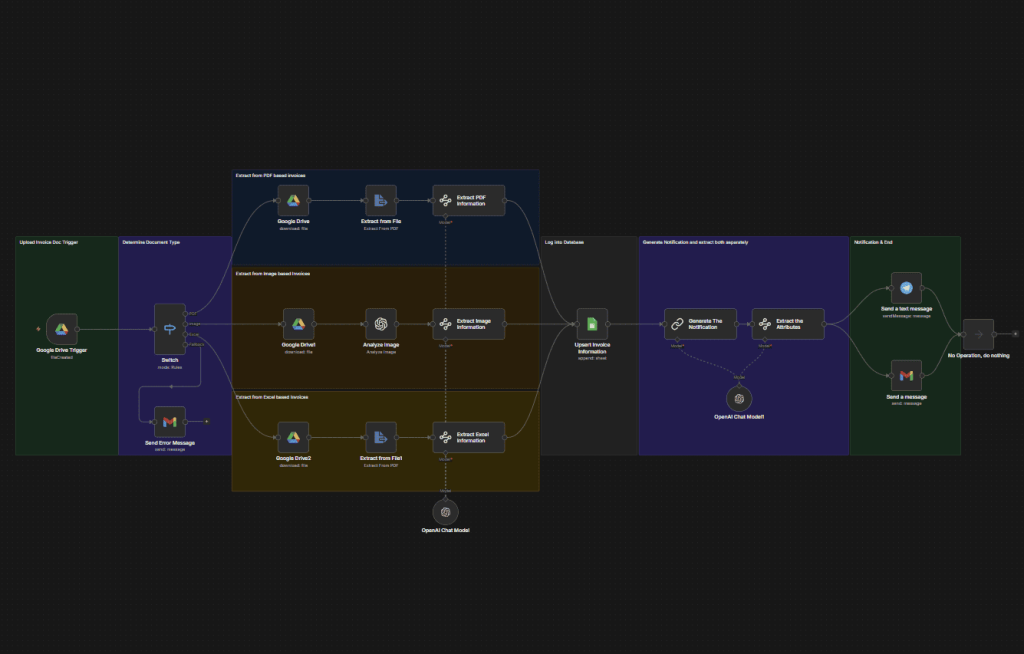
The same pattern works for processing supplier invoices into accounting software, parsing job applications into recruitment CRMs, classifying customer support emails by urgency, extracting structured data from quotes for comparison – basically anywhere a human is currently reading unstructured text and copying bits of it into a form.
- Rough cost: £1.5k–£6k setup depending on document variety, £100–£400 per month ongoing including LLM API costs.
- Who this is for: businesses with high volumes of inbound documents or emails that need to be turned into structured data. Especially good if you’ve ruled out off-the-shelf solutions because your data is too messy or too specific.
- What to avoid: fully autonomous processing of anything financial or contractual. Always keep a human review step on outputs that touch money, even if it’s a 30-second confirmation. The cost of one wrong invoice processed silently outweighs the time saved.
5. Build an internal AI assistant your team actually uses
The cheapest on the list, the easiest to set up, and one most SMEs sleep on.
Every business has a knowledge problem. Where’s the latest version of the supplier terms? What’s the standard price for a Y6 service? What’s our policy on weekend callouts? Who do I contact at supplier X? Half your team’s questions to each other are knowledge-retrieval questions, and the answers are scattered across Drive, Notion, email, and the founder’s head.
An internal AI assistant: Claude Projects, ChatGPT Team with custom GPTs, or a custom chatbot if you need something more bespoke – sits on top of your documents and answers questions for the team. New hire wants to know how to handle a refund request? Ask the assistant. Estimator needs the standard rates for next year? Ask the assistant. Director can’t remember which clause covered out-of-hours work in the standard contract? Ask the assistant.
The cost is trivial. £20–£25 per seat per month for ChatGPT Team or Claude. Upload your standard operating documents, your pricing sheets, your contract templates, your FAQ. Train the team to ask it first, ask each other second. The compounding time saved is real – and the answers get better the more documentation you feed it, which incidentally forces you to actually document things, which is a positive externality on its own.
- Rough cost: £20-£25 per user per month for off-the-shelf. £3k-£10k setup if you want a custom-branded assistant that integrates with your existing tools.
- Who this is for: literally every small business with more than two employees and any meaningful amount of internal knowledge that lives in people’s heads.
- What to avoid: treating the AI’s first answer as gospel. It can still be wrong, especially on numbers and specific clauses. Use it to surface where the answer lives, then verify against the source document.
Which one should you implement first?
A rough decision tree based on what hurts most:
- You miss inbound calls regularly. Start with the voice agent.
- You’re slow to respond to web leads. Start with SMS speed-to-lead.
- You’re paying people to copy data between systems. Start with the CRM/system sync.
- You’re spending hours a day reading and re-typing emails or documents. Start with document parsing.
- Your team keeps asking each other the same questions. Start with an internal AI assistant.
If more than one of those describes you, start with whichever one is bleeding the most measurable time or money this month. Don’t try to do all five at once. The single biggest mistake I see SMEs make with AI is buying tools for five problems and implementing none of them properly.
What this looks like in practice
You don’t need a tech team to do this. You need:
- A clearly-scoped problem worth at least 5 hours a week of measurable time.
- Either someone in-house who can wire it up using n8n / Make / Zapier and an LLM API, or an external consultant who can build it for you.
- A willingness to leave a human review step in place for the first 30–60 days while you watch it work.
If you’ve got that, AI implementation in 2026 is not a moonshot. It’s plumbing. Boring, useful plumbing.
If you’d like to talk through which of the five would pay back fastest for your business, you can book a call with me here – I’ll run you through what will have the biggest impact for your business.